
Topic
| Security Council Crisis Committee | Topic | Member states | Links and documents | Contact |
|---|
Topic: Situation in South Sudan
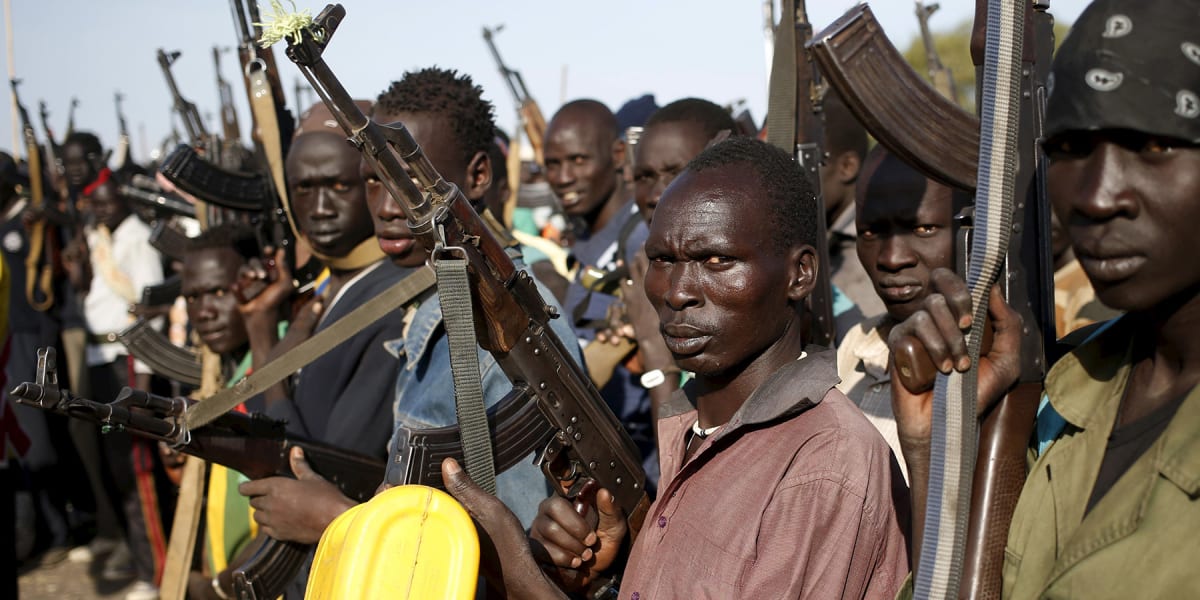
This year’s Security Council Crissis Committee concerns itself with the complex and numerous humanitarian challenges that South Sudan, the youngest country of today's world, is currently facing. Armed conflict, climate shocks, under-funding of humanitarian aid and a deteriorating economy are causing hunger and displacement, preventing such a young country in its pursuit of prosperity and development. Often overlooked, the situation in South Sudan is a cause of global humanitarian concern.
In 2011, South Sudan, a landlocked country in East Africa, proclaimed independence from Sudan through a referendum, where 98.83% of the 12.8 million population voted in favor of separation.[1] It is a member of the United Nations[2], the African Union[3], the East African community and the Intergovernmental Authority on Development.
South Sudan first freed itself from British colonial rule on January 1st 1956, when the Republic of Sudan became a sovereign State, which was consisted of today's Republic of Sudan and the Republic of South Sudan. However, even before its independence it has been plagued by decades of civil war, also known as the South Sudanese Wars of Independence. The first war took place between 1955 and 1972, with the Second War having occurred between 1983 and 2005. Consequently, the people of South Sudan were forced to face displacement and major destruction. Both wars killed more than 2.5 million people, seeing many more become refugees.
Not long after its independence, another civil war escalated in South Sudan, now referred to as the South Sudanese Civil War. It broke out as a result of political power struggles in the country, where the ruling party was accused of being autocratic and neglecting promises made before coming to power.[4] Amid those accusations, the president of South Sudan accused his vice-president and other accomplices of attempting a coup d’etat, because of which civil war broke out.[5] The military forces in Uganda, along with UN Peace keepers got involved in order to reestablish peace.[6] In the following years, multiple armed conflicts have emerged, which were all followed by peace deals not long after. The war has taken over 400,000 lives, where some horrible atrocities, the most notable of which is the Bentiu Massacre of 2014.[7]
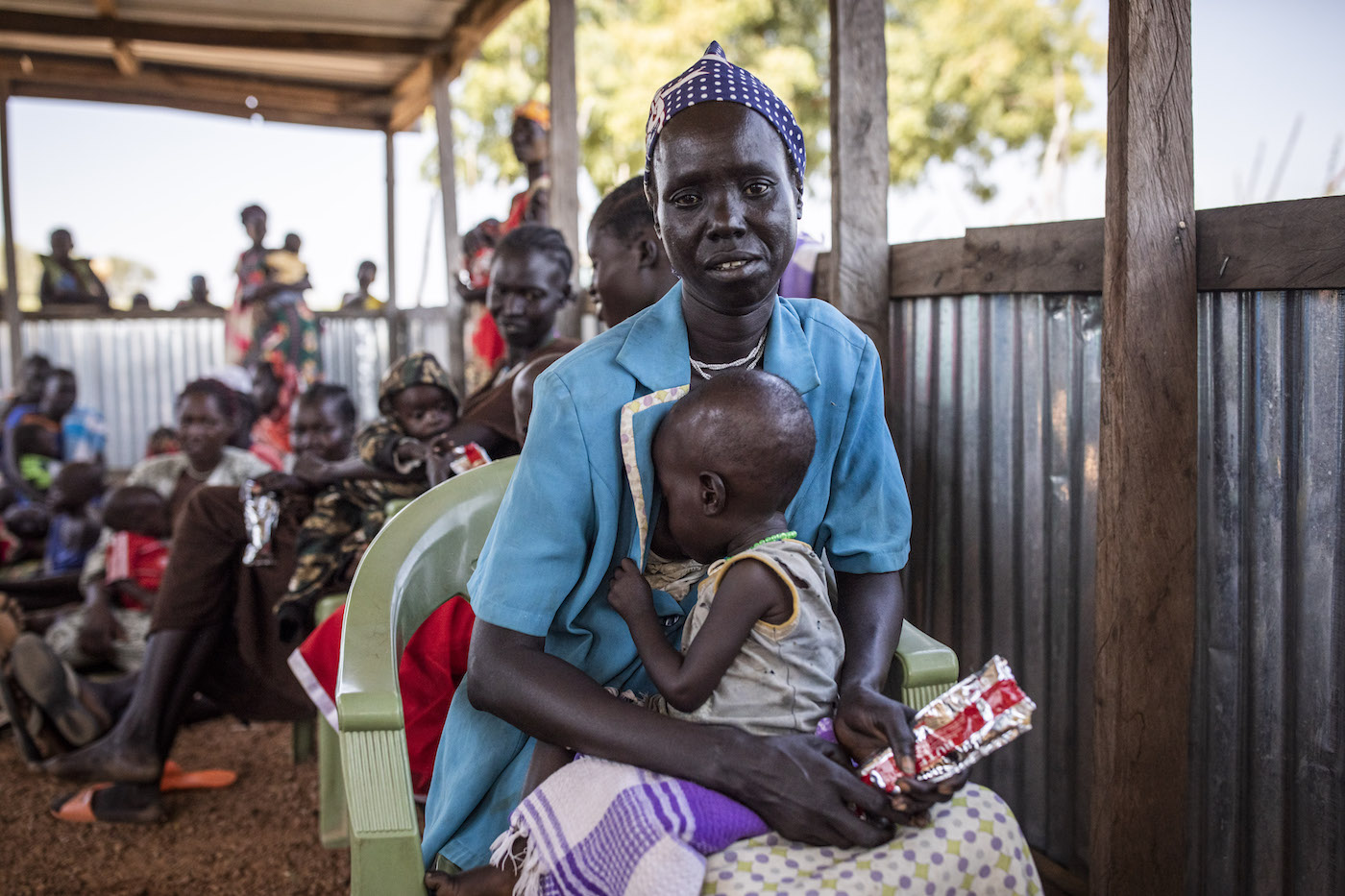
As of today, community level violence is still present. The UNMISS reports that, between April and June 2024, there were over 1000 victims of intercommunal and political violence. As of yet, no democratic elections have taken place in South Sudan, with the first being scheduled for 2026.[8] Following the arrest of vice-president Machar in 2025, the country was once again in crisis, because of which United Nations Secretary General Antonio Guteres has stated that the peace agreement is in shambles and that South Sudan is on the brink of civil war.[9]
Even though 11 years have passed since the independence of South Sudan, not all territorial questions have been resolved. The oil rich region of Abyei is still a disputed piece of territory between Sudan and South Sudan. No referendum was ever held in Abyei, although it was supposed to take place back in 2011, leaving its people deprived of their right to self-determination. Because of this, the region also faces difficulties in receiving the necessary humanitarian aid, since the uncertain territorial boundaries leave the region vulnerable to raids. [10]
South Sudan tragically is a place where numerous human rights violations occur regularly. After its independence, attempts to prevent rebellions caused villages to burn, the murder of civilians, and rape of many women and girls.[11] The current child marriage rate in South Sudan is 52%,[12] with the recruitment of child soldiers also being very much present. [13]
The people of South Sudan also face challenges in the form of water scarcity, because of dry weather, insufficient access to wells, while the water that is accessible through water pipes often is not safe to drink.
According to the United Nations Office for the Coordination of Humanitarian Affairs (OCHA), in 2021 8.3 million people of South Sudan were in need of some form of humanitarian assistance,[14] out of which nearly 4.5 million were children. Many reports have shown that South Sudan has one of the worst health indicators in the world, high mortality rates, and an alarming insufficiency of doctors and hospitals.[15]
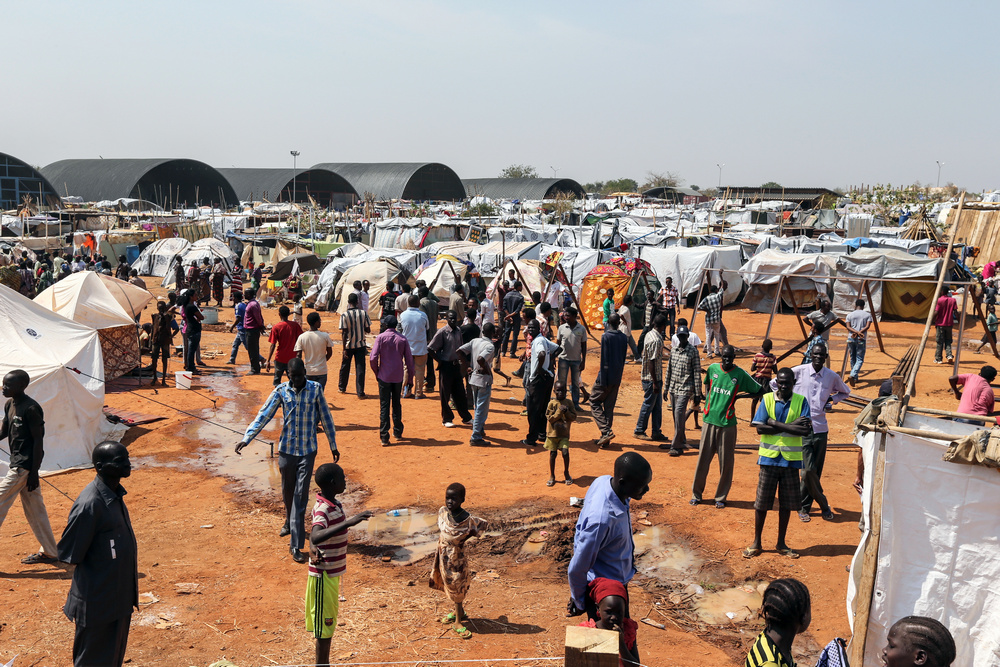
South Sudan has also faced grave refugee challenges. According to UNHCR, since 2023, South Sudan saw around 1 million refugees from Sudan seek shelter from conflict, while close to 700.000 people from South Sudan have returned.[16] Reports from 2016 estimated that one in five people of South Sudan were internally displaced.[17]
However, conflicts are not the only cause of displacement. According to OCHA, as a consequence of climate change, floods in South Sudan have affected 1.4 million people, displacing them in search for higher grounds.[18] Climate change is also severely affecting precipitation, to which South Sudan is very vulnerable due to the fact that 85% percent of its population rely on rainfed subsistence agriculture.[19] The flooding has also discouraged people from owning livestock, and pushed them towards relying on humanitarian aid.[20] The scarcity in sources of livelihood in South Sudan also increases the risk of the emergence small, local conflicts as a form of competition among people, aiming to securing food and water. Malnutrition and hunger are present all around the country.[21] In 2024, floods have displaced around 379.000 people in South Sudan and the Abyei area.
Although South Sudan has received support from the United Nations both through peacekeepers and humanitarian aid, the crisis it is facing still does not receive sufficient international recognition. As the youngest country in the world, South Sudan also bears the title of being one of the least safe countries in the world,[22] being overwhelmed with local conflicts and the aftermath of decades of civil wars, a stagnating economy which relies on unsustainable industries that have not been utilized to their full potential,[23] environmental degradation, internal displacement and famine. It is up to the United Nations and its members to express solidarity, take action, and bring hope to millions of people that have been prevented from living with dignity.
Proposed Discussion Questions on the Committee Topic:
- What measures can the international community take to prevent a renewed civil war in South Sudan, including measures to avoid major acts of violence and address local conflicts that threaten the country’s stability?
- How can the international community more effectively support South Sudan in adapting to severe climate-related challenges and in providing long-term solutions for millions of internally displaced people?
- What concrete steps can South Sudan, with the proper international assistance, take to strengthen its legal framework and enforcement mechanisms to reduce the country’s extremely high rate of child marriages and gender-based violence?
[1] https://peacekeeping.un.org/sites/default/files/past/unmis/referendum.shtml, https://www.cia.gov/the-world-factbook/countries/south-sudan/#people-and-society
[2] https://news.un.org/en/story/2011/07/381552
[3] https://web.archive.org/web/20110812031145/http://www.au.int/en/content/african-union-welcomes-south-sudan-54th-member-state-union
[4] https://web.archive.org/web/20230329132518/https://ssnanews.com/index.php/2013/09/05/the-splm-and-the-rise-of-autocracy-in-south-sudan/
[5] https://web.archive.org/web/20170829215731/https://www.nytimes.com/2014/01/10/world/africa/new-estimate-sharply-raises-death-toll-in-south-sudan.html
[6] https://web.archive.org/web/20181130113211/https://www.bbc.com/news/world-africa-25759650
[7] https://web.archive.org/web/20181008022704/https://abcnews.go.com/International/wireStory/report-400000-excess-deaths-south-sudan-58090309 , https://www.reuters.com/article/us-southsudan-unrest-toll/study-estimates-190000-people-killed-in-south-sudans-civil-war-idUSKCN1M626R/
[8] https://www.reuters.com/world/africa/south-sudan-postpones-long-delayed-election-by-two-years-presidency-says-2024-09-13/
[9] https://news.un.org/en/story/2025/03/1161666
[10] https://www.thenewhumanitarian.org/news-feature/2025/03/03/we-dont-have-protection-worsening-crisis-disputed-abyei
[11]https://web.archive.org/web/20110317113359/http://english.aljazeera.net//photo_galleries/africa/201111010324526960.html
[12] https://www.girlsnotbrides.org/learning-resources/child-marriage-atlas/regions-and-countries/south-sudan/
[13] https://www.bbc.com/news/world-africa-29762263
[14] https://reliefweb.int/report/south-sudan/south-sudan-humanitarian-needs-overview-2021-january-2021
[15] https://web.archive.org/web/20140408090727/http://www.sudantribune.com/spip.php?article1616
[16] https://www.unhcr.org/where-we-work/countries/south-sudanartType=bar&contextualDataset=BUD&tableDataView=absolute
[16] https://reliefweb.int/report/south-sudan/2016-south-sudan-humanitarian-needs-overview?dataset=POP&yearsMode=range&selectedYears=%5B2012%2C2026%5D&level=OPR&category=PTY&fundingSource=ALS&compareBy=%5B%22category%22%5D&levelCompare=%5B%5B%22OSSD_ABC%22%5D%5D&viewType=chart&chartType=bar&contextualDataset=BUD&tableDataView=absolute[17] https://reliefweb.int/report/south-sudan/2016-south-sudan-humanitarian-needs-overview
[18] UN Office for the Coordination of Humanitarian Affairs (OCHA), ‘South Sudan: Floods snapshot (as of 8 November 2024)’, 8 Nov. 2024.
[19] Mayen, J. V., Wood, E. and Frazier, T. G., ‘Practical flood risk reduction strategies in South Sudan’, Journal of Emergency Management, vol. 20, no. 8 (July 2022), https://web.archive.org/web/20230921175912/https://www.unops.org/news-and-stories/stories/roads-to-food-security-in-south-sudan
[20] Mayen, J. V., Wood, E. and Frazier, T. G., ‘Practical flood risk reduction strategies in South Sudan’, Journal of Emergency Management, vol. 20, no. 8 (July 2022).
[21] https://www.unicef.org/southsudan/press-releases/hunger-and-malnutrition-deepen-conflict-and-access-constraints-persist-south-sudan , Food and Agriculture Organization of the UN (FAO) et al., The State of Food Security and Nutrition in the World 2024 (FAO/IFAD/UNICEF/WFP/WHO: Rome, 2024).
[22] Institute for Economics and Peace (IEP), Global Peace Index 2024: Measuring Peace in a Complex World (IEP: Sydney, June 2024).
[23] World Bank Group, ‘Country engagement note for South Sudan for the period FY21–FY23’, Report no. 158008-SS, 15 Apr. 2021.